What Is Amazon FBA Automation? Complete Beginner's Guide (2026 Edition)
Amazon FBA automation has become a popular 'done-for-you' model for investors who want an online business without managing daily operations. Here's how it actually works.
Introduction
Amazon stands as one of the world's largest online marketplaces with millions of competing sellers. Among emerging business models, Amazon FBA automation has gained traction among entrepreneurs seeking online ventures without daily operational involvement. This guide explores what automation means within Amazon FBA, its viability, operational mechanics, profit potential, associated risks, and suitability for different investor types.
Understanding Amazon FBA First
Before exploring automation, understanding Amazon FBA (Fulfillment by Amazon) is essential. This service allows sellers to dispatch products to Amazon warehouses, where Amazon manages inventory storage, order packing, customer shipments, customer service, and return processing. Sellers focus on product selection and marketing while Amazon handles logistics and fulfillment, enabling faster scaling.
What Is Amazon FBA Automation?
This is a business model where sellers delegate most operational tasks to third-party agencies or teams. Rather than personally managing the store, investors typically employ a "done-for-you" approach covering product research, supplier sourcing, listing creation and optimization, inventory management, pricing adjustments, PPC advertising, customer service, and order monitoring. The objective transforms Amazon FBA into a semi-passive or managed income system, where the investor primarily provides capital while experts operate the store.
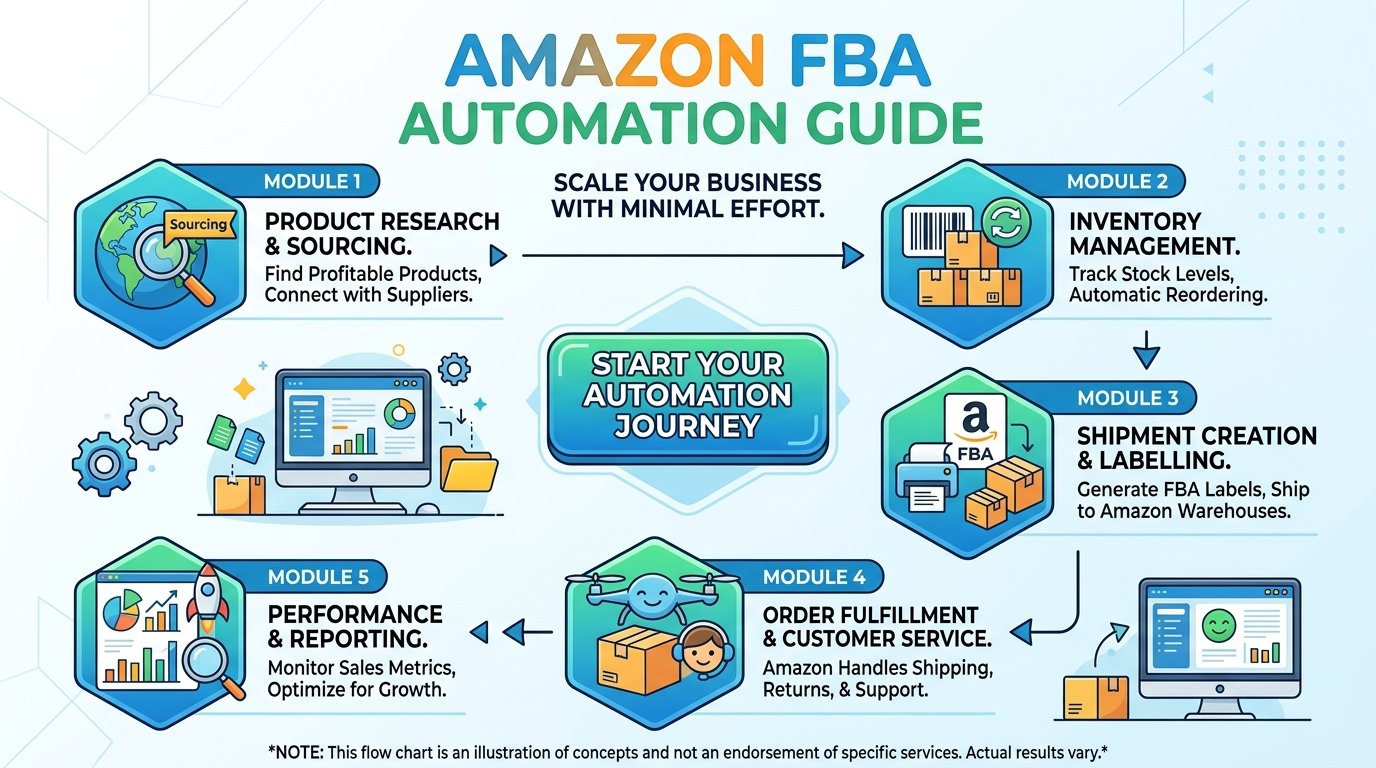
How Amazon FBA Automation Works (Step-by-Step)
1. Business Setup
An Amazon seller account is established, including professional seller registration, tax and payment configuration, and marketplace region selection (typically US, UK, or UAE). Automation providers typically assist with compliance and initial setup.
2. Product Research & Selection
Automation teams employ data tools identifying products with high demand, low to moderate competition, strong profit margins, stable sales history, and lightweight shipping. Frequently targeted categories include home organization, kitchen accessories, fitness equipment, pet supplies, and lifestyle gadgets.
3. Supplier Sourcing
Teams locate manufacturers or wholesalers — typically from China, US-based suppliers, or private label manufacturers — negotiating unit costs, minimum order quantities, packaging specifications, and shipping terms. This phase critically determines overall profit margins.
4. Branding and Listing Creation
Products receive branding and Amazon listing placement including title optimization, bullet point composition, keyword research, high-quality imagery, and A+ content for brand-registered sellers. Listing optimization directly impacts ranking and conversion.
5. Inventory Shipment to Amazon FBA
Products travel from suppliers to Amazon warehouses, where Amazon manages storage, assigns warehouse distribution, and prepares items for expedited delivery. The store becomes sales-ready at this point.
6. Launch and PPC Advertising
Visibility generation involves Amazon PPC campaigns — Sponsored Products, Sponsored Brands, and keyword targeting. Automation teams continuously adjust bids, keywords, and budget to optimize advertising cost of sales (ACoS).
7. Order Fulfillment & Customer Service
Post-sale operations include Amazon-managed shipping, return processing, and customer query management. This is where automation creates "hands-off" operation for investors.
8. Scaling the Store
Successful products lead to expansion through increased advertising budgets, new product variations, additional offerings, and marketplace expansion (UK, Canada, Europe). Scaling is where long-term profitability emerges.
Why People Choose Amazon FBA Automation
- Time freedom — no daily operational management, customer service, or manual inventory tracking.
- No technical skills required — providers manage the technical elements.
- Scalability — Amazon provides existing traffic, fulfillment infrastructure, and immediate global reach.
- Passive income potential — businesses can become semi-passive once stable.
Costs Involved
Initial investment: product inventory, Amazon seller fees, branding and packaging, advertising budget, and automation service fees — ranging from several thousand dollars upward depending on scale.
Ongoing costs: PPC advertising, inventory restocking, Amazon storage fees, and service/management fees.
Profit margins: healthy businesses target 15–30% net margins, higher with strong branding and lower during initial scaling.
Risks of Amazon FBA Automation
- Market competition — rapid product copying, price undercutting, and saturation.
- Inventory risk — unsold stock accrues storage fees and ties up capital.
- PPC dependency — paid ads can raise costs and reduce margins without optimization.
- Agency dependence — results hinge on the quality of your automation provider.
Amazon FBA Automation vs Traditional FBA
| Factor | Traditional FBA | FBA Automation |
|---|---|---|
| Time required | High | Low |
| Skill needed | Medium–High | Low |
| Control | Full control | Delegated |
| Profit potential | High | High |
| Learning curve | Steep | Minimal |
Who Should Consider Amazon FBA Automation?
This model suits busy professionals, investors seeking passive income, entrepreneurs wanting scalable ecommerce exposure, and capital-rich individuals with limited time. It's unsuitable for people expecting instant profits, those unwilling to invest capital, or risk-averse beginners.
Final Thoughts
Amazon FBA automation functions as a managed ecommerce investment model rather than rapid wealth generation. It integrates Amazon's global infrastructure, data-driven product selection, professional store management, and scalable advertising. For suitable investors, it provides ecommerce entry without daily operational stress — but success requires strategic planning, adequate capital, and execution quality.